Most B2B sales teams have experienced the same frustration: a pipeline full of names that don't convert. Plenty of contacts, not enough clarity. The volume looks right on paper, but the quality isn't there when it counts.
For one enterprise software company targeting accounting and finance decision-makers, that frustration had a name: inconsistency. Their existing demand generation programs weren't producing the signal quality they needed to scale — and sales teams were spending too much time sorting through leads rather than engaging the right ones.
They needed something different. Not more leads. Better leads.
The Challenge: Volume Without Signal
The company's situation isn't unusual in enterprise software. When you're selling to mid-to-large enterprise accounting and finance teams, you're dealing with a sophisticated, selective audience. These are people who evaluate solutions carefully, involve multiple stakeholders, and move at a deliberate pace.
Their existing programs were generating contacts — but the contacts weren't actionable. Three problems kept surfacing:
Fluctuating volume. Lead flow was unpredictable. Some months produced more than the team could handle. Others left the pipeline dry. There was no consistency to build a reliable forecasting process around.
Lack of context. Even when leads came in, they came in cold. Sales reps had a name, a company, maybe a title — but none of the background they needed to have a meaningful first conversation. What challenges was the prospect dealing with? What was their current solution? Were they actually evaluating alternatives?
Limited visibility. There was minimal insight into where prospects stood in their buying process. Role, seniority, technology environment, decision-making authority — none of it was being surfaced consistently.
The result: sales teams were spending hours qualifying leads that should have arrived pre-qualified, and losing time that should have been spent advancing real opportunities.
"The challenge was not attracting interest. It was identifying the right people, with the right intent, at the right moment."
The PMG360 Approach: Multi-Touch Engagement Built for Precision
PMG360 built a program structured around one core principle: qualification and insight first, not just initial response. The solution had three interconnected layers.
ICP-Driven Targeting
Before a single contact was reached, the team built a detailed ideal customer profile and mapped it against PMG360's first-party database of accounting and finance professionals. The ICP wasn't a rough sketch — it specified role and seniority, company size and vertical, technology environment, and buying authority and influence.
This meant that every prospect in the program was there because they matched the criteria the client's sales team actually needed to see — not because they happened to be on a list.
Multi-Touch Outreach
Rather than relying on a single channel, the program combined digital and live touchpoints to create continuity across the buyer journey.
Email outreach served as the educational layer — nurture-focused messaging designed to introduce the company's value proposition and reinforce its relevance to accounting and finance teams at different stages of awareness. These weren't generic blasts. They were sequenced to build understanding over time.
Telemarketing provided the live qualification layer. Real conversations with real prospects, designed to confirm interest, validate fit, and gather the kind of contextual insight that email alone can't surface. The two channels worked together, not in parallel. Email opened the door. Telemarketing walked through it.
Custom Qualification Framework
Every lead that came out of the program was run through a custom qualification framework built around the buying signals that actually matter to enterprise software sales teams: role and influence in the buying process, current solution environment and evaluation stage, project timeline and decision-making urgency, and key challenges and strategic priorities.
By the time a lead reached the sales team, it came with a complete qualification profile — not just contact information.
The Result: Consistent, Qualified, Ready
The outcome wasn't measured in raw volume. It was measured in pipeline quality.
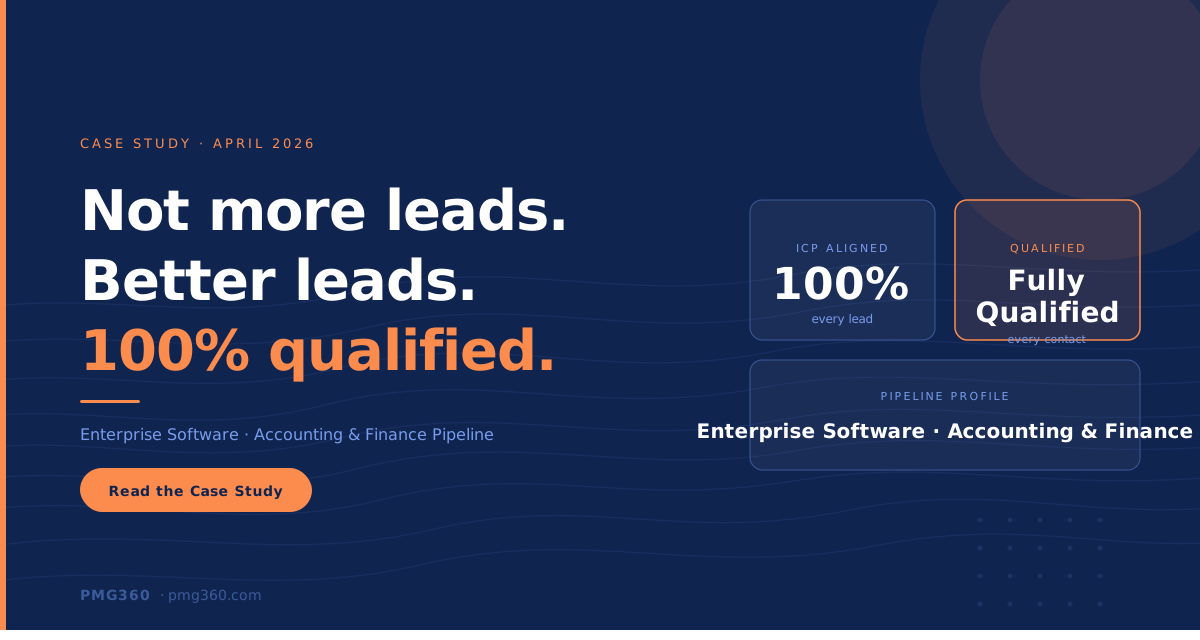
100% ICP-aligned leads. Every contact delivered through the program met the agreed-upon criteria. No exceptions, no approximations. The client's sales team could trust that every name on the list belonged there.
Fully qualified on every contact. Complete qualification data accompanied every lead — not as a bonus, but as a standard. The qualification framework was applied consistently across the entire program.
Rich context on every prospect. Sales reps knew who they were calling before they picked up the phone. They understood the prospect's role, their technology environment, where they stood in the evaluation process, and what challenges were driving the search for a new solution.
What sales teams received wasn't just a list of contacts. It was a ready-to-engage pipeline with everything needed for targeted nurture and informed first conversations:
- Who the prospect was — complete role, seniority, and buying authority context
- What they cared about — key challenges, priorities, and pain points surfaced during qualification
- Where they stood — current solution environment and evaluation stage documented
- Timeline and urgency — project timeline and decision-making urgency validated through live conversation
The Business Impact
The structural change to how leads were sourced and qualified produced ripple effects across the entire go-to-market motion.
Lead quality improved. Shared qualification standards and rigorous ICP alignment meant both the demand generation team and the sales team were working from the same definition of a good lead — and both were accountable to it.
Personalization increased. Because every lead came with deep contextual insight, reps could tailor their outreach to the specific situation of each prospect. Generic pitches gave way to relevant conversations.
Engagement strengthened. Follow-up became more relevant and timely. When reps knew exactly what a prospect cared about and where they were in their buying process, they could respond to actual signals instead of guessing.
Efficiency improved. The sales team stopped spending time on lead filtration and started spending time on lead engagement. The pipeline moved faster because every entry point was validated.
What This Looks Like for Enterprise Software Companies
If you're selling into accounting and finance at mid-to-large enterprises, the lesson from this case study isn't complicated: your sales team's time is too valuable to spend on unqualified contacts.
The difference between a pipeline that converts and one that stalls usually isn't the number of leads. It's the quality of the insight that comes with each one.
A program built on ICP-driven targeting, multi-touch engagement, and a rigorous qualification framework doesn't just generate demand. It generates the kind of demand that sales teams can actually act on — predictably, at scale, without sacrificing the quality standards that enterprise selling requires.