This year, PMG360 marks 20 years in business.
In B2B marketing, that span includes multiple resets. Email matured. Automation scaled. CRM systems became central to revenue operations. AI accelerated targeting and outreach. Buyer expectations increased. Data requirements tightened.
What rarely evolved at the same pace was structure.
Lead definitions drift. Follow-up slows. CRM fields multiply. Reporting shows activity but hides momentum. Over time, teams feel friction without always seeing the cause.
Technology cycles move quickly. Systems require discipline.
Over two decades, we’ve seen companies grow rapidly and then struggle with operational drag. We’ve also seen organizations revisit their fundamentals and regain speed.
The difference is rarely effort.
It is structure.
What Has Changed in 20 Years
The mechanics of b2b lead generation services have shifted significantly.
Two decades ago, reach created advantage. Distribution and access were differentiators. Today, relevance determines engagement. Precision targeting determines performance. Timing determines conversion.
Automation reduced manual execution. It also increased dependency on clean definitions. AI introduced speed and scale. It also raised the cost of structural weakness.
CRM systems evolved from databases to revenue platforms. They now house marketing workflows, sales processes, reporting frameworks, lifecycle stages, and increasingly complex crm implementation services designed to connect these functions more effectively.
That evolution introduced complexity.
Buyers changed as well. They research independently. They expect clarity quickly. They respond to credibility and structured messaging.
Here is a simplified view of how the landscape evolved:
Then vs Now in B2B Marketing 📊
| Earlier Years |
Today |
| Reach-driven campaigns |
Precision targeting and segmentation |
| Basic CRM tracking |
Full lifecycle revenue tracking |
| Manual list building |
AI-assisted data enrichment |
| Campaign focus |
System focus |
| Volume emphasis |
Data integrity emphasis |
Technology improved.
Expectations increased.
The need for operational clarity became stronger.
What Has Not Changed
Some fundamentals remain steady.
Structure determines scalability.
Fast follow-up determines meeting rates.
Data integrity determines ROI.
ICP clarity determines lead quality.
Sales enablement determines conversion velocity.
When these weaken, friction appears gradually.
Leads enter the system but stall.
Sales teams work harder without proportional return.
Reporting becomes more complicated without becoming clearer.
Here is where pipelines quietly break:
Where Pipeline Friction Begins 🔎
| System Area |
What Happens |
Business Impact |
| ICP drift |
Targeting widens over time |
Declining lead quality |
| CRM ownership gaps |
Definitions shift |
Reporting confusion |
| Follow-up delays |
Response time increases |
Lower meeting rates |
| Data decay |
Deliverability drops |
Reduced campaign ROI |
These patterns are not dramatic.
They are cumulative.
Twenty years allows pattern recognition. It becomes easier to identify structural signals early and correct them before performance declines materially.
Anniversary Special Offer 👇
What We Have Built Over Two Decades
PMG360 began as a focused B2B publishing platform. It evolved into a structured marketing and revenue operations partner.
Today, that foundation includes:
20 Years in Operational Scale 📈
• 230 million first-party prospects
• A 12-step quality control process
• HubSpot partnership and CRM implementation services
• Sales enablement frameworks
• Engage360 multi-channel programs
• AI-driven outreach and b2b data licensing services that help support more accurate targeting and data refinement
Each capability was added in response to real operational needs.
Clients required more than reach. They needed alignment between marketing and sales. They needed CRM clarity. They needed consistent follow-up structures. They needed accurate data to sustain performance.
The result is not a collection of services.
It is an integrated system refined over time.
Experience compounds when it is applied consistently.
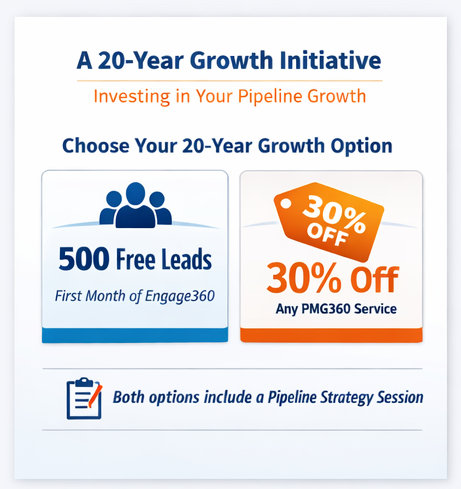
A 20-Year Growth Initiative 🎯
After two decades of working with B2B organizations, we are marking this milestone by investing back into our clients’ pipeline growth.
This initiative is structured around early momentum.
Your 20-Year Growth Options
Option 1
500 free leads in the first month of Engage360
Option 2
30% off any PMG360 service
Both options include a structured pipeline strategy session.
Why structure it this way?
Early engagement momentum determines long-term ROI. Front-loading pipeline activity provides clarity faster. Reduced friction in month one allows teams to evaluate system performance under real conditions.
This is not designed as a short-term promotion. It is a structured growth accelerator for organizations that want to refine targeting, follow-up timing, and CRM alignment.
The objective is clarity.
Clarity reduces risk.
Clarity increases conversion velocity.
Clarity builds sustainable growth.
Operational Lessons From 20 Years
Over time, certain truths repeat.
Volume without structure collapses.
Automation without oversight introduces error.
CRM drift compounds gradually.
Data hygiene determines long-term performance.
Sales enablement determines revenue outcomes.
Here is what we consistently observe:
Lessons That Hold 📘
| Lesson |
Practical Implication |
| Volume requires alignment |
Scaling without definition increases friction |
| Automation requires review |
Workflows need recalibration |
| CRM requires ownership |
Clear field governance prevents confusion |
| Data requires discipline |
Verification protects ROI |
| Sales requires enablement |
Structured follow-up drives conversion |
These lessons are not theoretical.
They are observed across finance, technology, legal, manufacturing, and professional services environments.
Operational discipline produces predictable outcomes.
Where the Industry Is Headed
AI will continue accelerating execution.
Multichannel engagement will become standard.
CRM systems will carry greater accountability.
Data governance will become non-negotiable.
Revenue teams will be evaluated on pipeline efficiency, not activity volume.
Organizations positioned for this future will focus on structural clarity.
AI performs best with clean data.
Multichannel outreach requires message coordination.
CRM optimization requires governance.
Revenue accountability requires measurable definitions.
Experience provides perspective.
Perspective enables preparation.
Ready to Strengthen Your Pipeline?
If you are reviewing your lead generation strategy for 2026, this is an appropriate time to evaluate structure, follow-up speed, and targeting accuracy.
Performance challenges often originate in system design. Reviewing ICP definitions, CRM configuration, and lifecycle stages frequently reveals practical improvements.
If any of these feel familiar:
| Symptom |
Likely Structural Cause |
| High lead volume, low meeting rates |
Targeting drift |
| Sales feedback inconsistency |
Qualification misalignment |
| CRM reporting confusion |
Field definition gaps |
| Campaign ROI flattening |
Data quality issues |
It may be time to reassess structure.
Anniversary Special Offer 👇